Extreme Spins Licence: UKGC Status and Curaçao Claims
 Available in GB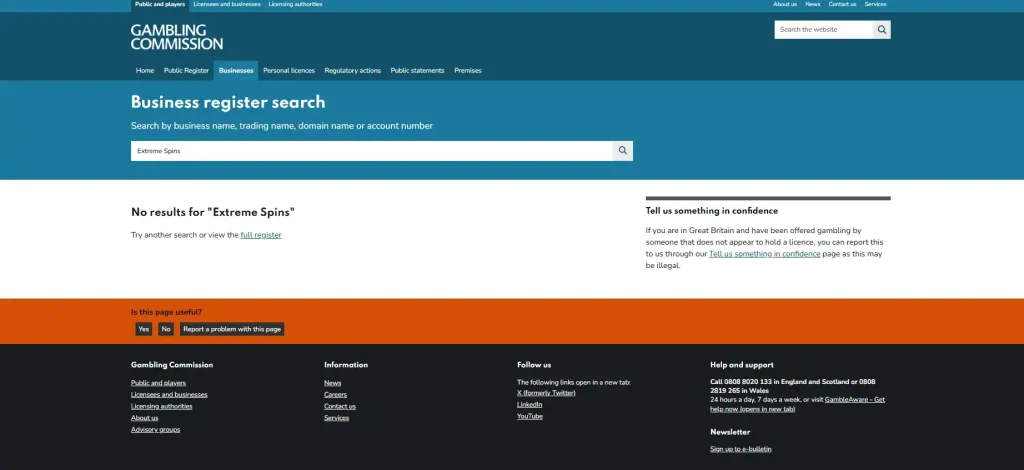
Extreme Spins regulatory status
No UK Gambling Commission licence was verified for Extreme Spins in the current UKGC business register. That matters because businesses providing remote gambling to consumers in Great Britain need the appropriate Gambling Commission operating licence, regardless of where the business is based. This is distinct from the fact that UK-player use of Extreme Spins is operationally evidenced: availability does not equal UKGC authorisation. Current Curaçao licensing details remain unresolved because third-party sources conflict and no current CGA certificate for Extreme Spins has been directly verified. For that reason this guide does not publish an active Curaçao licence, licence number or expiry date.
Table of Contents
- The UKGC register is the starting point
- Great Britain requires a licence for remote gambling
- Great Britain and Northern Ireland are not the same regulatory scope
- GAMSTOP is a UKGC-licensed-market protection, not a badge to infer
- Why the Curaçao claim is left unresolved
- What a UKGC licence would normally connect to
- How to repeat the licence check yourself
- Complaints and licence status answer different questions
- What the Extreme Spins licence picture means in Great Britain
Section element
No Extreme Spins licence was verified in the current UKGC business register.
Operators serving consumers in England, Scotland and Wales need the appropriate UKGC licence.
No active licence or licence number is published here without a direct regulator certificate.
The UKGC register is the starting point
The UK Gambling Commission public business register is the primary source for checking whether a business holds an operating licence issued by the Commission. The register can be searched by business name, trading name, domain name or account number.
No UKGC licence was verified for Extreme Spins in the current register check. That means this guide does not describe Extreme Spins as UKGC licensed, UKGC regulated or covered by UKGC operator protections. It also does not use a third-party casino review, a logo or a claimed licence badge to fill that gap.
The broader trust overview combines this register fact with complaints and other risk signals, but this page keeps the licence question narrow.
Great Britain requires a licence for remote gambling
UKGC remote-sector guidance states that a business needs a Gambling Commission licence if it provides facilities for remote gambling to consumers in Great Britain. The rule applies even when the business itself is based outside Great Britain. For an online casino, the relevant authorisation is normally a remote casino operating licence for the casino activity being provided.
This is why “accepts UK players” and “UKGC authorised” are not interchangeable descriptions. Extreme Spins has operational evidence of UK-player use, but the current register check does not verify a UKGC licence for the brand. A website being reachable, accepting GBP or appearing in UK-focused reviews does not create regulatory authorisation.
| Statement | What it means | Extreme Spins position |
|---|---|---|
| Used by UK players | Operational access or player use is evidenced. | Supported by the current source record. |
| UKGC licensed | A current operating licence is recorded by the UK Gambling Commission. | Not verified in the current register. |
| Offshore licence claimed | A licence outside Great Britain is asserted or described. | Current Curaçao status is unresolved. |
Great Britain and Northern Ireland are not the same regulatory scope
The UK Gambling Commission’s jurisdiction under the Gambling Act 2005 covers Great Britain: England, Scotland and Wales. The Commission states that it does not regulate gambling activity in Northern Ireland in the same way, because gambling there is a devolved matter, apart from its separate National Lottery role and certain circumstances involving equipment or advertising.
Northern Ireland’s framework is based on the Betting, Gaming, Lotteries and Amusements (NI) Order 1985 as amended in 2022. This distinction matters because using “UK” as shorthand can hide two different regulatory contexts. This page therefore uses “Great Britain” when describing the standard UKGC remote-licensing requirement.
GAMSTOP is a UKGC-licensed-market protection, not a badge to infer
For applicable remote UKGC licences, the Commission’s social responsibility code requires participation in the national multi-operator self-exclusion scheme. The UKGC also explains that GAMSTOP ONLINE is designed to restrict access to websites and apps run by gambling businesses licensed in Great Britain.
That regulatory context should not be reversed into an assumption about Extreme Spins. Because no UKGC licence was verified for the brand, this guide does not state that UKGC or GAMSTOP protections apply to an Extreme Spins account. The distinction is the same one used on the payment rules: regulated-market rules can explain the benchmark without being presented as proof of this operator’s compliance.
Why the Curaçao claim is left unresolved
Several third-party sources have described Extreme Spins as Curaçao licensed, while a fresh LCB investigation reported that the operator and licence credentials it examined could not be matched in the Curaçao Gaming Authority registry it checked. No direct CGA certificate tied clearly to Extreme Spins and its present domain has been verified.
Because licence number and expiry details are high-risk facts, this guide does not choose between conflicting third-party claims and publish one as settled. It does not state an active Curaçao licence, a licence number or an expiry date. A current direct regulator certificate would be the evidence needed to upgrade that position.
What a UKGC licence would normally connect to
A verified UKGC licence would connect an operator to Licence Conditions and Codes of Practice, regulatory supervision and the licence-specific requirements that apply to its activities. For remote operators, this includes rules around customer protection and, for applicable licences, participation in the national multi-operator self-exclusion scheme.
Those protections should not be described as Extreme Spins features unless the licence itself is verified. The same principle applies when reading the bonus terms: Great Britain rules can provide a comparison benchmark, but they do not prove that a non-verified operator is supervised under that framework.
How to repeat the licence check yourself
Use the UKGC public business register rather than a search-engine snippet or casino footer. Search the brand name, any current trading name you can independently identify and the present domain. A genuine register entry should lead to a named business account with licence status and activity details. If a brand is not returned, do not substitute a review-site badge for that missing regulator record.
For an offshore claim, use the same principle: start from the regulator’s own certificate or register and match the operator name, licence reference and domain where those fields are provided. If those pieces cannot be tied together, describe the licence as unresolved instead of publishing a number copied from a third party. That method is slower than reading a footer badge, but it prevents a claimed credential from being mistaken for a verified one.
Complaints and licence status answer different questions
A licence check establishes regulatory authorisation. It does not by itself predict whether an individual withdrawal will be fast, slow or disputed. Conversely, a complaint does not create or cancel a licence. Extreme Spins has a current pattern of withdrawal-related allegations across complaint surfaces, which is why the complaints treats user experiences as their own evidence layer.
Keeping those questions separate prevents two common errors: treating a licence badge as proof that every service outcome is good, or treating one complaint as proof of a regulator status. The Extreme Spins review uses both types of evidence without confusing their roles.
A licence check is strongest when three elements line up: the legal operator name, the gambling domain and the regulator’s own current record. A licence number quoted only by an affiliate or review is not enough if the regulator record cannot be matched to the same operator and domain. That is why this page keeps the Curaçao question unresolved rather than choosing one of several conflicting third-party descriptions.
The UKGC question is more direct for Great Britain. The Commission’s public business register is the appropriate place to verify whether a remote gambling business holds the relevant British operating licence. No Extreme Spins entry was verified in the register check used for this guide. That finding should be described narrowly as a failed verification result, not converted into a universal legal conclusion about every UK jurisdiction.
Domain matching is part of that verification. A regulator record for a similarly named company is not enough unless the operator and gambling domain also correspond to the service being reviewed.
Check the regulator record again before relying on the result.
What the Extreme Spins licence picture means in Great Britain
For Great Britain, the verified regulatory position is specific: remote gambling operators serving consumers there need the appropriate UK Gambling Commission licence, and no Extreme Spins licence was verified in the current business register. That is the strongest available local-regulator fact.
The offshore picture is less settled. Current Curaçao claims conflict across third-party sources and have not been upgraded with a direct current CGA certificate, so no active offshore licence or licence number is published here. Treat availability, licence status and complaint history as separate questions, and give the regulator register the highest weight when the issue is authorisation.